Play is the child’s natural form of communication and being playful promotes bonding, happiness and laughter. Play is spontaneous, meaningful, enjoyable, not goal oriented and voluntary. It begins from the very first moment infants are born, as they move their arms and legs around, discover their bodies and observe the world around them.
As children move through the stages of play development, they gain a greater understanding of themselves, others and they become increasingly able to process their own thoughts, feelings and experiences.
Play is an integral part of healthy development, and just as adults engage in sports, mindfulness, music or other hobbies in order to decompress after the hustle and bustle of everyday life, children use play in a similar way. Children use play to make sense of their experiences as it is the most natural, comfortable and safe medium for them to engage in. It is also a self-healing process in which children can explore situations that they found disturbing.
Play provides an opportunity for conflicts to be resolved and feelings to be communicated. Whether it was an argument with a sibling or friend or being told to stand in front of the class at school when they didn’t want to, it allows children to cope with these uncomfortable situations and make the unfamiliar familiar.
Therefore, letting children play or being playful with them after you have argued over doing the dishes or who started it first when fighting with their sibling, will help them not only make sense of what happened but will bring them back into a calm state ready to reflect on what happened earlier.
How to incorporate playfulness into your household:
- Playfulness can be incorporated into all instrumental care.
Something as unpleasant as changing dirty diapers can become a fun game of peekaboo, tummy tickles or blowing raspberry kisses. This symbiotic enjoyment also wires babies brains towards positive relationships and the expectation that future relationships with others will also be enjoyable.
- Following your child’s lead when you are engaging in play time together.
It is rare that children get much control as they grow and develop. They are often told what to wear, what to eat, what they are going to do… Therefore, when your child enters their play world, let’s try and follow their lead and mirror them. If they pick up a horse and say it’s a frog, try to let go of your adult rational instinct and let it be a frog! In the same sense, children don’t need lots of new and shiny toys as their imagination can work in wonderful and adaptive ways.
- Giving your children time to sit, without an immediate plan.
In our current fast paced culture, we have been trained to constantly keep moving just like hamsters running in their exercise wheels. Rarely do we or children have time to sit back and reflect. Children need time. Junk modelling is a great opportunity to give children the occasion to let their creativity emerge without the constant threat of the sand timer running out before their next activity. By giving them empty cardboard boxes, old containers, egg boxes, empty loo rolls and some masking tape, they are free to use their imagination and problem-solving skills to turn discarded items into spaceships, towers, houses, creatures or whatever they decide to invent.
It is important to note that the most creative and free play comes following a period of rest.
- Funsequences in multi-children households.
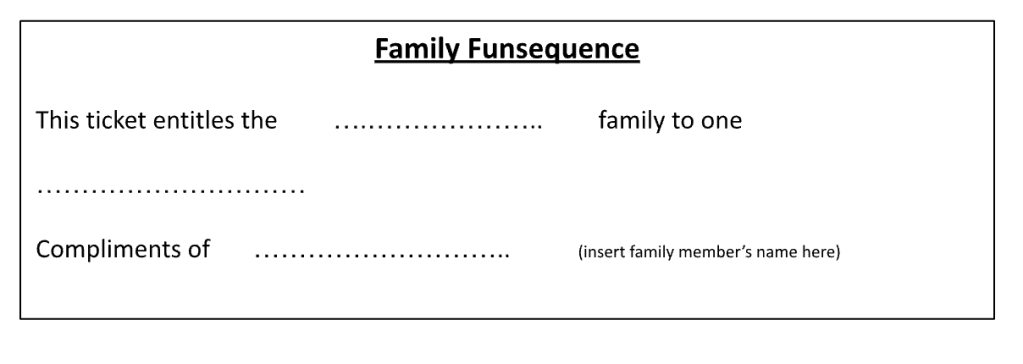
As parents instil their values in their children, there is significant importance placed on rewards and consequences. Yet it is also important to acknowledge what is difficult for a particular child. Funsequences can be a great activity for the whole family to engage in and to recognise every one’s hard work. This can look different for each child or parent. For example, if the children in the household are 10, 6 and 5, the hard thing for the 10-year-old might be having to learn and recite his time tables, and for the 5-year-old, it might be getting dressed and ready for school by him/herself. This allows the whole family to develop a healthy work and play balance.
Each family member gets to choose some potential activities for the Funsequences which they can ‘claim’ when they have done the hard stuff. Examples of activities might be, a baking project, a family trip to the fair or the beach, a family walk and picnic, an hour of board game play. It is important that these activities are carried out together and do not include electronic devices.
 Celine's Play Therapy Services
Leave a comment